The history of human settlement has always been associated with some form of transportation. Whether it was horse trails, waterways, rail lines, or roads, all paths attracted settlers and enhanced the prosperity of the towns that grew around them. Today, our most prevalent forms of transportation are the car, airplane, and the networked computer (Garreau 1991). We build shopping centers at the intersection of highways, entertainment en route to the airport, and business centers around high speed data cables. Businesses measure their success based on the amount of product or service transferred across these transportation routes, and residences are evaluated by commuting distances.
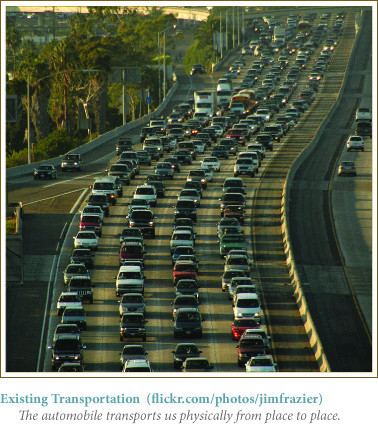 Air travel is often considered to be the future of transportation, but it has a long way to go to replace automobiles. Cars are currently popular, but that choice is currently losing its effectiveness as traffic congestion and commuting time increases. The latest construction of the built environment places uses farther and farther from each other. Commute times are the longest ever with a national average of 24.3 minutes (Longley 2005). Many planners feel that the congestion and wasted time has pushed commuters to their limit. Many are looking for ways to ease the automobile from dominating the transportation market.
Of the three transportation modes, we may want to look at the possibility of building a city around the most recent transportation device, the networked computer. The computer isn’t your typical transportation device. It doesn’t transport human beings. However, it has provided a way to virtually transport nearly everything. The networked computer makes business exchanges, retail transactions, social gatherings, and even connects people through video conferencing. The world’s most popular transportation system is no longer fixed at any geographical location. As such, cities that grow around transportation could be located nearly anywhere.
The technological revolution has led to globalization of nearly everything. The internet and the computer have eliminated the need for physical human interaction. China may as well be located down the street and India is only a technical support phone call away. Logistic corporations such as UPS and DHL are expected become the top businesses in America by providing global resources to a local market at a moments notice. Many people are not aware of the changes that are occurring in business. UPS is expanding its services to include Supply-Chain Solutions for any business. This service is loosely defined and can be almost facet of a business. UPS not only delivers packages, but now they also assemble the products, attach labels, place clothing on hangers, execute technical repairs, and answer customer support questions (Salter 2004). The supply chain market could total nearly 3 trillion dollars. But what does that mean to urban design? It means that when someone orders a sweatshirt and a camera online, UPS does not need to pick it up from the retailer because it is already in their warehouse. It means that when someone sends their laptop in for repair, it doesn’t go all the way to Dell computers. The laptop is repaired by UPS technicians. It means that every item an individual desires is only half as far away as it was before. The power of the networked computer connected to the power of the supply-chain creates a possibility of same-day online service. The globe just got much smaller and the reason to build cities around technology just got that much more important.
Partially due to outsourcing and globalization, the American economy is changing. More incomes are earned in service positions rather than production positions. In fact, nearly 75% of all employment is in the service industry (Herzenberg, Alic and Wial 1998). Regardless of the type of industry, almost all business is now completely dependent on technology. Production facilities are largely labored by computers, robots, and machines. Service industries often rely on technology for a variety of tasks such as marketing, scheduling, documentation, and even client interaction. Many companies allow their employees to work from home, and many self-employed individuals set up home offices with computers, fax machines, and video conferencing to keep them connected to other business professionals (Lessinger 1991). This concept of telecommuting reduces the need for urban offices, long commutes, and living near your business colleagues.
Technology has provided people with the means of doing business from any location. Additionally, the production industry no longer dominates the economy and does not require masses of laborers to live near income centers. Some are now referring to this as the “death of distance” era, because distance has become irrelevant (Karlgaard 2004). Soon, people will no longer need to live near cities, allowing individuals to move to ideal living communities, rather than ideal work centers. Some of these ideal living communities will be in downtowns and some will be in developed first ring suburbs. But a new market will also begin to emerge. People who left small towns for city jobs will now have an opportunity to move back. As people begin to leave the cities, many will seek quality community living in small towns (Lessinger 1991).