As small towns absorb population migration, they will be faced with the challenge of growth. Recently, urban sprawl has placed undue stress on the environment, public health, and urban infrastructure. The growth response of small towns must be different from the exhausting development of urban and suburban areas.
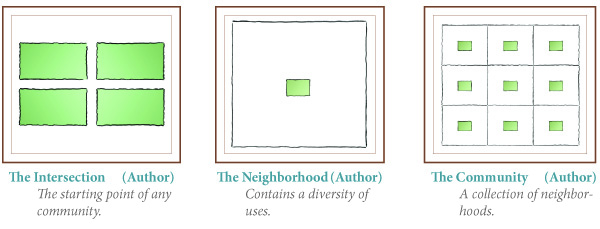
Examining growth in small towns is a great way to recognize the patterns of all our communities. Because they are small, they are much more fragile environments and provide strong indicators of successful or unsuccessful growth. Typically, every community starts with an intersection. That intersection eventually experiences healthy growth and becomes a neighborhood. The neighborhood has more than one use. A collection of these mixed-use neighborhoods form a complete community. Each community contains all necessary daily uses. Theoretically, clusters of neighborhoods could continue indefinitely. Because each is well-mixed, there is no sprawl condition forcing people to leave their community. Yet, they still retain the freedom to visit other communities for specialized goods and services. The following diagram illustrates the pattern of HEALTHY GROWTH.
Sprawl
What exactly is sprawl? Sprawl is an unhealthy growth pattern that doesn’t continue the traditional pattern illustrated above. The traditional community is balanced. There are suppliers and there are consumers. Both are mixed evenly throughout the community in balanced neighborhoods. In a sprawling community, there is a lack of balance. The new developments are not mixed neighborhoods. The consumer must transport themselves to a supplier region. And similarly, the suppliers must depend on consumers outside their region. The condition of sprawl implies that both do not occur in the same place. For example, mass developments of housing is “residential sprawl” (see diagram on left below). But sprawl can also be in the form of “core sprawl,” where the supply component of the neighborhood is developed without the consumers. Shopping malls and office parks are examples of core sprawl (see diagram on right below). Sprawl is synonymous with “incomplete neighborhoods.” It is the addition, or expansion, of neighborhoods with single-use only environments.
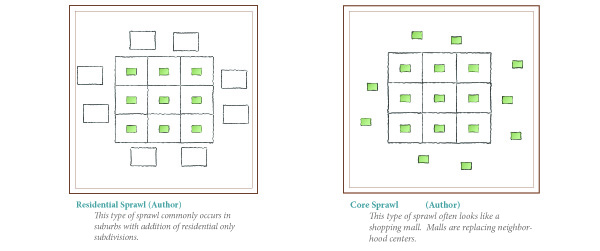 Contrary to how the word sounds, a large collection of neighborhoods does not necessarily indicate a sprawling environment. As long as each neighborhood is complete and balanced, the community will not sprawl. There are many examples of large collections of balanced neighborhoods. Cities usually name these neighborhoods: uptown, downtown, chinatown, little italy, mid-town, etc. These neighborhoods add to successful communities. A growing small town should strive to add complete balanced neighborhoods in order to continue their healthy growth pattern and preserve the appeal of living in a small town.
Growth Options
Growth can occur on two different fronts, the interior and the exterior. Ideally, all urban growth would occur internally. This type of development is referred to as infill development and often occurs on brownfield sites that were formerly occupied by other uses. This type of growth is better for the community because the infrastructure already exists and the new development will complement the existing uses in the neighborhood. However, infill growth is not always an option. Sometimes, a municipality will become congested and require outward expansion. This expansion should be led by the public sector with specific plans for the growth and how it will be limited.
 The diagram “Fringe Growth” illustrates unplanned growth at the urban boundary. If growth occurs at the entire edge boundary, then the distance from one part of the growth neighborhood to another part of the neighborhood could be as great as the length of the entire municipality. This type of growth increases the distance between daily uses and requires a greater dependence on transportation. Increased transportation use not only wastes resources, but also wastes time and sacrifices our health. Additionally, the transportation options are limited. Mass transit is an inefficient solution for this unconsolidated growth because it needs to reach too many areas. Thus, users must become dependent on individual transportation devices, such as the automobile. If growth hadn’t occurred on the entire fringe, then the new neighborhood would have less of a transportation demand. Exterior edge growth needs to occur as the addition of complete neighborhoods to specific planned locations on the community edge. This type of growth is how towns and cities grew for thousands of years up until the industrial age. When we became able to extend our transportation network through the use of the machine, we forgot the traditional principles of urban growth and planning. Growth in the form of complete neighborhoods reduces the distance between daily uses and decreases the dependence on transportation. Automobiles, boats, trains, and planes are still available to transport people, but become optional rather than required. Complete neighborhood growth actually enables greater freedom to be where people want to be. And with less time spent commuting, there is greater freedom to spend one’s time.